


Supported Employment Listening and Learning Sessions
Discuss existing barriers to employment for people with disabilities.
Individuals with disabilities and their families are invited to join the Arc of Illinois, the Self-Advocacy Alliance, Sibling Leadership Network and Illinois Assistive Technology Program for a series of Supported Employment Listening and Learning Sessions.
You’ll have the opportunity to discuss the barriers you see in employment for people with disabilities and learn more about policy changes that could affect people with intellectual and developmental disabilities through the Workforce Innovation and Opportunity Act (WIOA) and Illinois Employment First in Illinois.
- April 10 Webinar
1 to 2:30 p.m.
Click here to register for the webinar.
- April 11 Session in Bloomington-Normal
9:30 to 11 a.m.
Marcfirst, 1606 Hunt Drive, #1A, Normal, IL 61761
Click here to register for the Bloomington-Normal session.
- April 18 Session in Dixon
9:30 to 11 a.m.
Kreider Services, 500 Anchor Road, Dixon, IL 61021
Click here to register for the Dixon session.
Sessions in Chicago and Edwardsville are to follow.
Email Meg Cooch at meg@thearcofil.org or call (773) 558-5136 for more information.
Individuals with Cerebral Palsy Needed for Dance Research Study

Study will investigate the effects of ballet dance class on stretch reflexes and spasticity.
The Neuroscience of Dance in Health and Disability Laboratory at the University of Illinois at Urbana-Champaign is doing a research study on physical rehabilitation in cerebral palsy.
The study will investigate the effects of a ballet dance class on the regulation of stretch reflexes and spasticity in individuals with cerebral palsy.
Participants must meet the following criteria:
- Be between the ages of 3 and 64
- Have been diagnosed with CP
No previous dance experience is required.
To participate and/or find out additional information, please contact Dr. Lopez-Ortiz at (217) 300-1022 or lopezort@Illinois.edu.
Parents Urged to Safely Store Cold and Flu Medications

Illinois Poison Center warns families of the risks associated with cold and flu products containing camphor.
The holidays may be over, but cold and flu season is far from finished. Between now and the end of winter, parents and caregivers across the state will scour their local pharmacies for relief from cold or flu symptoms for themselves and their children. However, some of these medications can do more harm than good when used improperly, and the Illinois Poison Center (IPC) is warning families to be careful about how they store the products they bring into their homes.
In 2017, the IPC managed three serious cases involving children who accidentally ingested over-the-counter cold symptom relief products containing camphor. All of them suffered from nausea, vomiting, drowsiness, and seizure-like symptoms, including tremors, shakiness and eyes rolling in the back of the head. All three required hospitalization, and fortunately, each child recovered.
“Thankfully, these cases have a happy ending, but they’re a reminder of just how toxic products all of us have at home can be,” says Carol DesLauriers, Pharm.D., D.A.B.A.T., Senior Director, IPC. “Anyone who spends time with young children needs to be aware of the danger and store these medications properly.”
Camphor is found in low concentrations in topical ointments, rubs and vaporizer solutions — e.g. Vicks VapoRub™, Vicks VapoSteam™ and similar name-brand and generic products — used to treat cold or flu symptoms, by either massaging them into the skin or adding them to humidifiers. When used as directed, these products are safe and can relieve coughs and congestion and soothe nasal passages. However, when swallowed, they can be toxic.
The IPC reported 372 cases of camphor poisoning in 2017, most of them from accidental ingestion. The majority of these exposures involved curious toddlers swallowing camphor-containing products. In other instances, children and adults mistakenly ingested substances with camphor, believing they were traditional liquid cough and cold medication. Camphor, a stimulant to the central nervous system, can cause nausea and vomiting, confusion, agitation, hallucinations, tremors, and seizures. Symptoms usually appear within 90 minutes of exposure.
If parents and caregivers have medications containing camphor in their homes, they should always store them out of reach and out of sight of small children. Many camphor-containing products — which include some arthritis topical creams, gels and patches, cold sore blister products and mothball formulations, in addition to cold relief medication — are not sold in child-resistant containers. It takes only a moment for a young child to swallow a few mouthfuls.
If you suspect someone has ingested camphor:
- Never induce vomiting
- Avoid giving them milk or oily foods
Similarly, if a camphor-containing product is in the eyes, rinse them thoroughly with room temperature water.
In all cases of suspected exposure to camphor, immediately call the IPC helpline at (800) 222-1222. To learn more about camphor, see a recent IPC blog post. For more information on medication safety and other topics from the IPC, click here.
IPC experts are available to provide information and treatment advice 24 hours per day, 365 days per year, including holidays. If you suspect that you or someone you know has been exposed to a potentially harmful substance, please call the IPC at (800) 222-1222. The call is free and confidential. For more information, visit the IPC’s website at http://illinoispoisoncenter.org.
Sensory-Friendly Santa Stops in Illinois

Participating malls across the state invite youth of all ages and abilities to meet Santa.
Autism Speaks is partnering with Cherry Hill Programs this holiday season to provide sensory-friendly Santa Experiences for families across the country.
All families of children with autism and other special needs can enjoy a visit with Santa in a more subdued and calm environment.
Click here for the list of Cherry Hill Programs Santa Photo Experiences in Illinois.
Sensory-friendly Santa events are free and keepsake photo packages will be available for purchase.
Free Developmental Milestone Tracker Available for Families
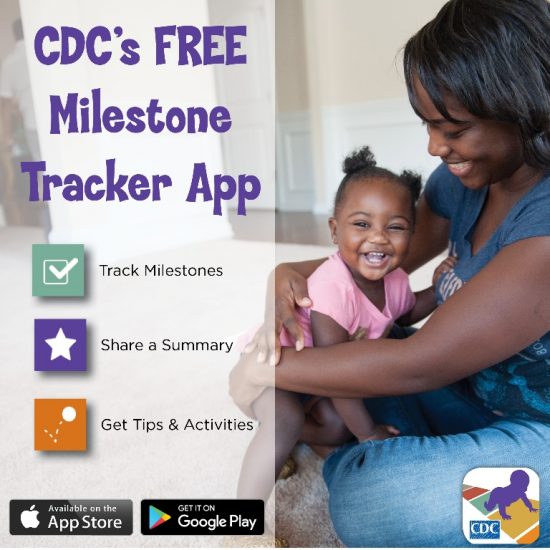
New app helps parents track their child’s development in a fun and easy way.
The Centers for Disease Control and Prevention (CDC) is pleased to announce the launch of CDC’s Milestone Tracker, a free app for tracking every child’s development in a fun and easy way. This app is one of a variety of free, family-friendly materials available through CDC’s Learn the Signs. Act Early. program.
“Skills like taking a first step, saying those first words, and waving ‘bye-bye’ are developmental milestones all parents anticipate and celebrate,” said CDC Director Brenda Fitzgerald, M.D. “This CDC Milestone Tracker app gives parents tips to help their child learn and grow, a way to track developmental milestones, recognize delays, and the ability to share this information with their healthcare provider.”
The new app offers:
- Interactive milestone checklists for children ages 2 months through 5 years, illustrated with photos and videos
- Tips and activities to help children learn and grow
- Information on when to act early and talk with a doctor about developmental delays
- A personalized milestone summary that can be easily shared with the doctor and other care providers
- Reminders for appointments and developmental screening
Learn more and get information on downloading the app at CDC’s Milestone Tracker website. The app is available in the App Store and on Google Play.
Although it is packed with parent-friendly features, healthcare providers can also use the app to help with developmental surveillance as recommended by the American Academy of Pediatrics. Early care and education providers can use it to better understand their students’ skills and abilities and to engage families in monitoring developmental progress.
Free Child Care for Children with Autism or Developmental Delays
CST Academy and Chicago ABA Therapy are offering a monthly night out for parents to enjoy themselves.
CST Academy, a Chicago therapeutic preschool program, and Chicago ABA Therapy are sponsoring an initiative to provide free child care for children with autism or other developmental delays so their parents can enjoy a night out.
The program aims to offer parents a monthly, scheduled “date night” or “parent(s’) night out.” Children can be dropped off at the program’s play space, where team members watch, engage and entertain them while parents have time to themselves.
Their team is a group of therapists and aspiring therapists with extensive expertise in speech and language development, occupational therapy, feeding therapy and ABA therapy.
The program is free to parents. A small donation to offset their costs would be appreciated but is not required.
Interested parents should click here to request more information.
New Transition Resource for Deaf or Hard of Hearing Teens

Online learning tools for parents and their transition age teens who are deaf or hard of hearing.
The transition from high school to the workforce or postsecondary education can be difficult to understand and navigate. Hands & Voices has announced the release of its online learning tool specifically for parents and their transition-age teens who are deaf or hard of hearing to support them as they begin this new journey.
Topics covered include:
- Laws and Key Information Parents Need to Know about the Transition Process
- From Parent Advocacy to Student Advocacy
- Technology Transitions
- The Parenting Aspects of Transition
- Strategies to Assist with the Process of Transition
Goals of the learning module are:
- To have a resource for parents and their transition-age teens that will support their exploration of life after high school.
- Parents will report knowledge and confidence in understanding postsecondary transition.
- Transition-age teens will report feeling more knowledgeable and prepared for the transition process.
Intended audience:
- Parents and their transition-age children.
- Teachers and support staff working with transition age students who are deaf or hard of hearing.
For more information and to register, click here.
Click here to read an interview with Lisa Kovcas about the transition tool.
Resources to Help Youth Cope with Traumatic Events

State Board shares resources for children, families and educators.
In response to the mass shooting in Las Vegas, the Illinois State Board of Education has compiled a list of resources for parents and educators to help children and youth handle traumatic events. The list was shared in a recent Weekly Message from State Superintendent Tony Smith, Ph.D.:
- Coping with Traumatic Events: Resources for Children, Parents, Educators, and Other Professionals from the Substance Abuse and Mental Health Services Administration (SAMHSA)
- Helping Children and Adolescents Cope with Violence and Disasters: What Parents Can Do from the National Institute of Mental Health
- Helping Kids After a Shooting from the American School Counselor Association
- Resources from the National Child Traumatic Stress Network
- Talking to Children About Tragedies & Other News Events from the American Academy of Pediatrics
Additional resources from the State Board on a variety of topics are available at https://www.isbe.net/Pages/Climate-and-Culture.aspx.
Autism Grant Available for Central Illinois Families
Grant from the Autism Society of Central Illinois aims to improve the life of an individual or child with autism.
The Blake Penner Memorial Grant was established by the Autism Society of Central Illinois in 2005 in honor of one special child. The grant program is designed to help families purchase items or services that will improve the life of an individual or child with autism. Examples of grant uses include adaptive bicycles, occupational therapy, physical therapy, speech therapy, educational consultant fees and social skills training.
Grant beneficiaries must be a person with autism spectrum disorder who lives within the central Illinois area (must live in Sangamon or Menard county or other qualifying zip codes listed on the Autism Society of Central Illinois’ website at http://autismcil.org/).
Applications are available here and must be mailed in by Nov. 3. Funds are limited, so apply early.
Free Webinar Series on Transition
“Next Steps to Adulthood: Planning for Transition” includes a free webinar series and in-person workshop.
The University of Illinois at Chicago Institute on Disability and Human Development (IDHD) Developmental Disability Family Clinics present “Next Steps to Adulthood: Planning for Transition,” a free webinar series and workshop. Families and professionals may register for all or select individual webinars to attend.
WEBINAR SERIES:
- Healthcare Transition of Young Adults with Autism and other Developmental Disabilities to Adult Systems of Care
Date: Wednesday, Oct. 4, 10 to 11 a.m.
Presenter: Kruti Acharya, MD, UIC Department of Disability and Human Development
Dr. Acharya will review the most recent data about healthcare transition for adolescents and young adults with intellectual or developmental disabilities, describe standard of care for health care transition and highlight strategies to support the transition to adult-centered health care. - Understanding the Components of Transition Planning for Youth with Autism
Date: Wednesday, Oct. 18, 10 to 11 a.m.
Presenter: Meghan Burke, Ph.D., BCBA-D, UIUC Department of Special Education
In this presentation, Dr. Burke will outline the components of transition planning for your child with autism. Specifically, she will discuss transition assessments and goals, student involvement and transition outcomes including post-secondary training and education, independent living and employment. - Employment Policy and Services for Transition-Aged Youth with Disability
Date: Wednesday, Nov. 1, 10 to 11 a.m.
Presenter: Kate Caldwell, PhD, UIC Department of Disability and Human Development
This presentation will give an overview of current policy affecting transition-aged youth with disabilities in the workforce. It will also discuss trends in the field, as well as strategies and best practices in disability employment services and supports. Finally, it will provide resources for those wishing to learn more. - What Happens Next? Exploring the World of Adult Services
Date: Thursday, Nov. 9, 10 to 11 a.m.
Presenter: Kathy Carmody, MSW, Institute on Public Policy for People with Disabilities
This presentation will discuss the community service system for adults with intellectual/developmental disabilities in Illinois, including eligibility requirements, funding options, service models and strategies to promote maximum effectiveness and satisfaction with services. Kathy brings over 30 years of experience in Illinois and an extensive background in helping families understand and navigate the adult I/DD community system.
IN-PERSON WORKSHOP:
- Transition Perspectives
Date: Friday, Dec. 8, 10 a.m. to 1 p.m.
Location: First Floor Auditorium, 1640 W. Roosevelt Road, Chicago, IL 60608 (UIC’s Disability, Health and Social Policy Building)
This in-person interactive workshop combines insights from all three webinars to discuss how transition planning impacts daily life, healthcare and employment opportunities. This is your opportunity to learn from three experts on transition best practices. Bring your questions!
REGISTER HERE: https://tinyurl.com/TransitionReg
Questions? Contact Susan Kahan at skahan@uic.edu or (312) 413-2652.
Continuing education credits are available with a $10 fee for professionals in the following disciplines: Advanced Practice Nurses, Registered Nurses, LPNs, Clinical Psychologists, Illinois Teachers Professional Development, LCSW, LSW, LPC, and LCPC, Licensed Dietitian Nutritionists (RD), Nursing Home Administrators, Occupational Therapists, Physical Therapists, Qualified Intellectual Disabilities Professionals and Speech Language Pathologists.
Click here for more information.